CUT
First Cut cut on what is said, then Next Cut to dress it. You no longer start from an empty timeline: you start further along.
Here is where the four to six hours went, and what is left of them.
| The task | By hand | With FULLCUT |
|---|---|---|
| Open, sort and relink the proxies | 15 min | 5 min |
| Separate the interviews from the cutaways | 20 min | 5 min |
| Listen through the interview to know what is said, and organize it by chapter | 2 to 3 h | 10 min |
| Sort the cutaways by category | 1 h 30 to 3 h | 25 min |
| Find one exact sentence | 10 to 20 min | 2 s |
| Your time | 4 to 6 h | 45 min |
The thankless part is done.
Middle column: the time it took us, here, before. Right column: measured on our own projects.Plug in the card and walk away. It sorts the project, opens every file, listens to what is said in it and flags whatever it is unsure about. Nothing is deleted.
Every sentence is written down, timestamped and searchable. Eight months later you are not looking for a file name: you are looking for what was said.
It has listened to everything. Ask it anything about the shoot: it answers with timecodes, and it tells you when the speaker corrects himself.
we train everyone in house· 00:38:02,
training is two weeks· 00:51:17. The second one is the cleanest, 4.1 s, and it cuts clean.
today we are at ninety two. Careful, he corrects himself two seconds later and says
ninety five.
Everything has been listened to. All that is left is to ask.
The project is sorted, every sentence is findable, and the assistant hands you the quote, the number or the angle you were after. You walk in the morning: the shoot is waiting for you in order.
Clean sorts the whole shoot. Derush organizes it by cutaway and by spoken line. Every shot listened to, every sentence timestamped. Nothing thrown away.
First Cut cut on what is said, then Next Cut to dress it. You no longer start from an empty timeline: you start further along.
Write your chapters, or ask it to suggest some. You correct them: it is your order that goes to the edit.
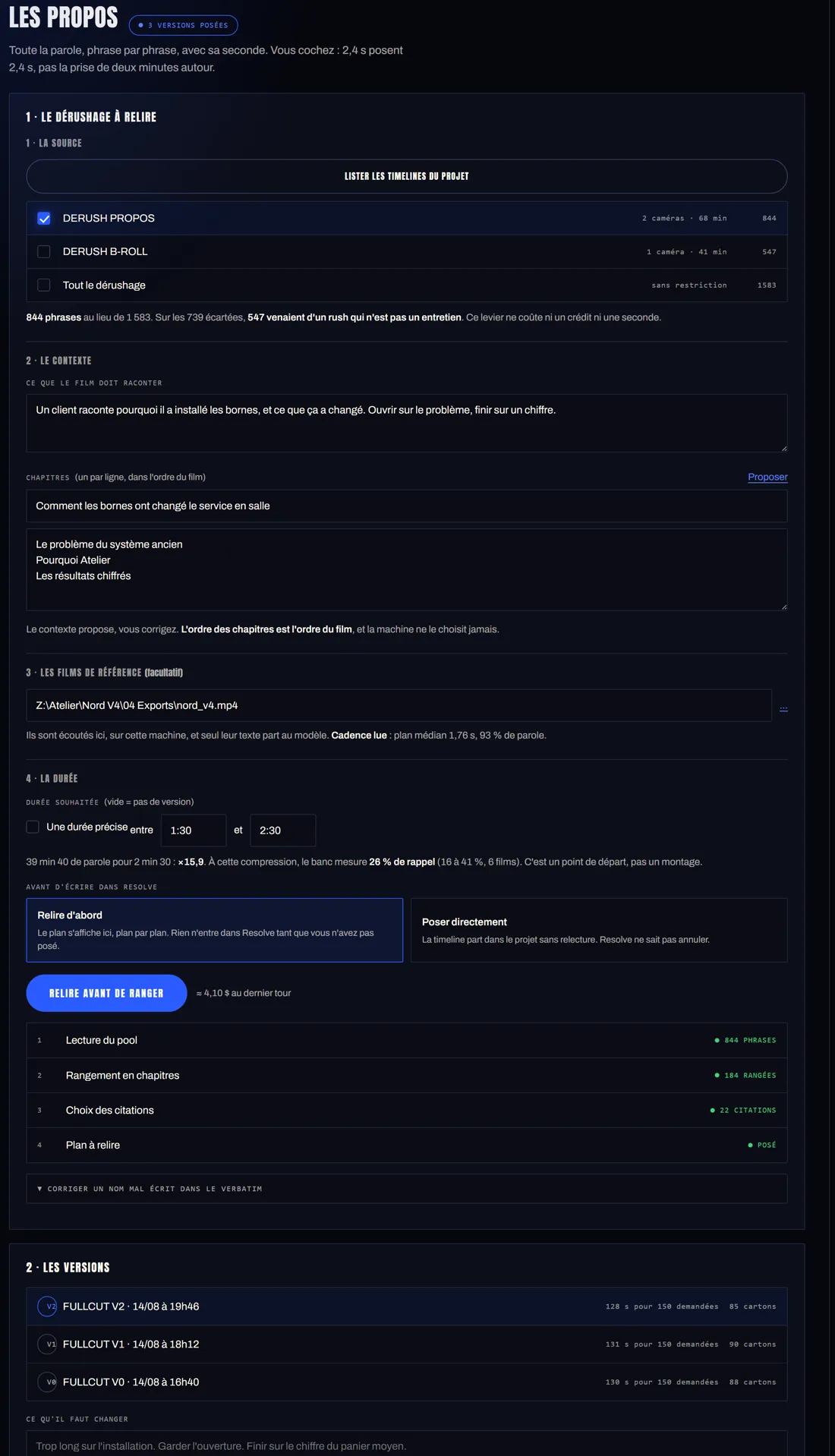
You write them, or it suggests some when inspiration is short.
Fixed, or flexible. It cuts on the sentence, never in the middle of a word.
One or more films whose build you like: it takes its bearings from them, for First Cut as for Next Cut.
It hands you a picture cut, built on what is said, editable shot by shot inside your project.
FULLCUT adds the cutaways, the music and the subtitles.
The blank page is gone. It arrives already cut.
First Cut lays the speech down in the order you gave, Next Cut dresses it, and everything stays editable, shot by shot, inside your Resolve project.
On a scripted shoot the material is not an interview: it is a script, setups, takes. TAKES listens to the whole shoot and lays every line onto a review timeline: one marker per setup, and every take of it in a row.
Every line is found and laid down, take after take. You no longer listen to find: you listen to choose.
By line, by shot size · close-up, wide · and in shooting order.
Add your instructions, the dialogue script, your own sorting notes: the classification bends to the way you work, and your corrections come before whatever the machine read.
The text, the script and the shot size are all computed inside the software. No online model, no credits, no data sent.
It sets up the comparison. You choose the take.
The review timeline lands in your Resolve project, ordinary and editable. TAKES does not grade the performance and picks no angle for you.
FULLCUT installs next to DaVinci Resolve Studio and works inside your project. The intelligence is one button away: everything local on your machine, or Claude for the steps that reason.
All local: sorting, Derush and transcription are computed at your place. Or plug in Claude, and pick the model, from the quickest to the finest.
In both worlds. When a step sends text to Claude, the screen names it: you know what leaves, and what does not.
No workflow to connect, no terminal: FULLCUT ships with its own graphs and talks to Resolve on its own.
These two models reason with Claude, so you need a Claude subscription. Clean, Derush and TAKES run without one.
SIGNS is a creative studio based between Paris and Geneva. More than two thousand films made around the world since 2017, for luxury houses, record labels, manufacturers and institutions.
 signsfilms.fr
A shot is missing, the client wants it in English, the music does not land right: it gets settled inside Resolve, without opening another piece of software.
Extend a shot that runs short, erase what is lying around in frame, build the shot that was never filmed.
The visual the edit is missing: generated, or edited from a frame of the film.
The line the mix is missing, in the voice of the film.
It clones your speakers' voices, translates inside each line's own slot, dubs it and syncs the lips. You get a complete timeline back: the original underneath, the dub on top.
At the film's exact length: composed, or pulled from your catalog and recut when the edit moves.
A conversation shot on several cameras, cut on whoever is speaking.
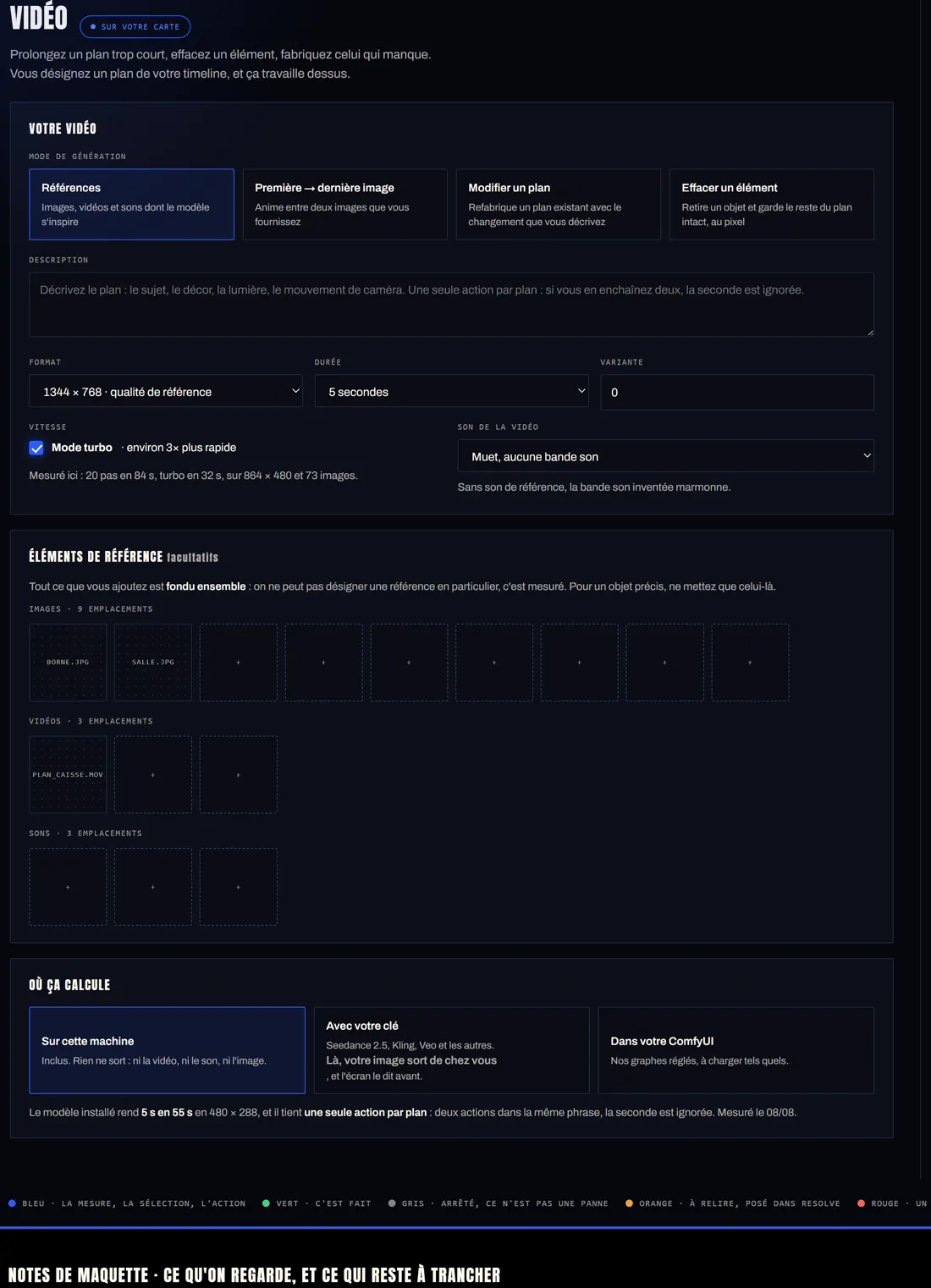
All six tools live in the same Resolve panel: you never leave your edit.
FULLCUT ships with its own graphs and sends them to the ComfyUI you already run. Its address, and that is all: your models, your machine.
For the online steps: your account, your rates. The screen always says which of the two is working.
Nothing scatters: what FULLCUT makes gets filed, like everything else.
One catalog is wired in today, with your own subscription. The others need an agreement with their publisher.
It reads your old Resolve projects and draws your grammar from them: how long your shots run, what you cover, how long you hold a face, how often you cut away.
It reads your project backups where they already sit, offline and read only. Nothing sent, no account, no box to untick.
The first five give it an idea of you. The ones after give it your signature.
No two editors cut alike, and that is exactly what it goes looking for in your work. Not the trade's average: your way.
Your old edits already exist. It does not wait for you to work with it to know your style.
All of it so that all you have left is the creative work.
One installer, modules that switch on. Perpetual license, updates included forever. Modules still to come will be sold separately.
The shoot sorted into bins, the speech logged, search by what was said.
Clean + Derush, plus the scripted shoot: takes grouped by line and shot size.
Clean + Derush, First Cut and Next Cut: the first version, then the dressing.
The whole editing path, scripted work included. Four models, one installer.
Video, image, music, voice · on your ComfyUI or with your own keys.
Editing, TAKES and the Studio IA module. One installer, rights that switch on.
Prices exclude tax, calculated at checkout · perpetual license, one user, two machines, updates included · modules still to come are sold separately · 14-day trial, no card · DaVinci Resolve Studio and any usage on your own keys not included
What is greyed out does not exist yet. The scripting interface FULLCUT needs is reserved for Studio by Blackmagic.
Fourteen days, no card, no watermark. Long enough for it to read your old edits, and to have learned your grammar before the next shoot even starts.
The application ships on 15 September 2026. Leave your address and we will send it to you first thing that day.
This address is used for that one message and nothing else. It is kept until 15 September 2026, then three months at most, and you can have it removed at any time by writing to [email protected].